Wednesday, August 21, 2013

Across Time and Across the Pond... Lady Almina and the Real Downton Abbey

So, for as much as I've been reading for the past year or so I haven't blogged about any of it. I'll blame school and all the crap that went down there (don't ask), but I've also sort of been floating and not really finding a book that holds my interest. That doesn't happen for me very often, but when it does it tends to last for a while. However, recently I've been interested in royalty and the history of the great heads of Europe.

My first princess that wasn't an animated Disney character was Princess Diana. I was six when Diana was killed in Paris, and while I don't remember much about it, I can remember how devastated people were when she passed away. It would seem fitting, in some morbid way, then that the fist princess I took interest in was Grace Kelly. Rear Window remains not only my favorite Grace Kelly film, but one of my favorite Hitchcock films of all time, right up there with North By Northwest. Grace Kelly's was a real life fairytale, the girl from Philadelphia staring some of the biggest movies of her day before meeting her real life prince. There are many interesting stories surrounding Grace Kelly, from her controversial death, to her relationship with her co-stars and Alfred Hitchcock, to the banning of her movies in Monaco, but she wasn't the only royal by any means to have an interesting life.
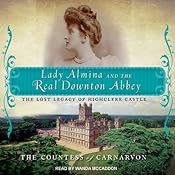

Lady Almina and the Real Downton Abbey is the story of Almina, the 5th Countess of Canarvon. The Carnavron family lives at Highclear Castle, the set of the British television series Downton Abbey written by Julian Fellows. Much like her fictional counterpart, Cora, Almina was an heiress, though Cora was American while Almina was British, whose money was used to rescue Highcleare from difficult financial times. The biographical account of Almina's life was compiled using Highcleare achieves and societal coverage from the late 1800s through WWI. The most interesting part of Almina's story for many comes with her financial support for an excavation led by her husband and Howard Carter in the Valley of the Kings in Egypt, an excavation that would lead to the discovery of King Tut's tomb. Almina's husband George was one of the fist victims of the Curse of King Tut, and the description of his passing is heart breaking.

Almina's passion for her husband and her country is touching, but what is missing from the account is a sense of person connection. The book does an admirable job of exploring Almina's contributions to Highcleare, but not much is said about her personal feelings about Highcleare. As a mother her past is almost overlooked, expect for a few sentences describing and ill-fated garden party with her son or the passion for fashion she passed on to her daughter. 

Overall, the book is an interesting history of the 5th Countess of Canarvon and a tumultuous time in both British and world history. If reading about garden parties and turn of the century coming out parties is of interest I would recommend reading this book. It is very well put together and the pieces from the Highcleare achieve included in the book are fascinating. 

Sunday, July 22, 2012

The Polar Express

Ok, so generally children's books don't actually need reviewing, but this may be my favorite book of all time. The Polar Express by Chris Van Allsburg is primarily a Christmas story, but to me it is so much more. Van Allsburg is a two time winner of the Caldecott Medal (once for Jumanjii in 1982 and once for The Polar Express in 1985). To put into perspective how important this book is to me it was the basis of my college admissions essay. While I loved the book growing up for its Christmas theme and the idea that if you believed long enough you might just get to see Santa, it has, over the years become something much more. Belief is one of those funny things that is really had to hang onto. It sticks with you for a very long time, yet always seems to disappear when you need it most. At least for me. But, somehow the ringing of a bell always seems to bring back my belief in the good that happens in the world.

I think I really need that today. The events in Aurora, Colorado Friday morning have left me really shaken. Maybe I am associating it with Columbine (one of the first major tragedies that I remember) or maybe it is just not being home and with friends that I can turn to and talk about everything... all I know is that even just staring at the picture of the train in the snow has somehow left me comforted.

Thursday, July 19, 2012

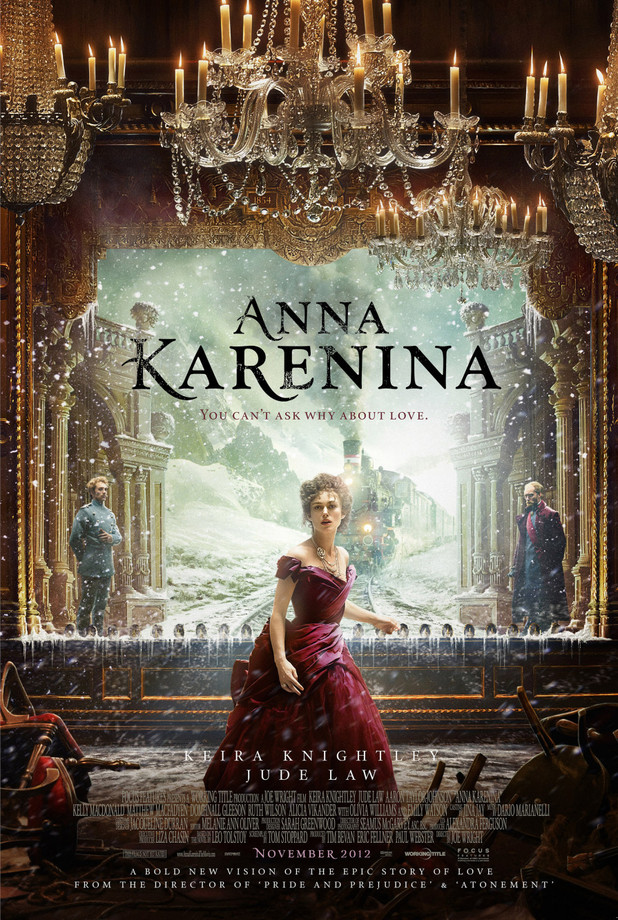
Anna Karenina

It is perhaps one of the most famous openings of a book, rivaled only by the writings of William Shakespeare and Charles Dickens. "Happy families are all alike; every unhappy family is unhappy in its own way." This is the sentence that starts off Leo Tolstoy's Anna Karenina. 

I read Anna Karenina two summers ago in between working and whatever household duties I had that day. The book is divided into eight parts, telling the story of Anna Karenina, her husband, Anna's affair, and the relationship trials of her sister-in-law Kitty. Perhaps it is because I do not have the same feelings of restlessness and hopelessness but I do not relate to Anna on any level much at all. I don't really identify with many of the characters at all. Perhaps Levin (Kitty's husband) if I had to pick. And I feel exceptional amounts of empathy for Anna's two children who never feel her love. 

The book is exceedingly well written, however. And perhaps the reason that I enjoy the character of Levin most of all is that he is semi-autobiographical (at least according to theory) for Tolstoy himself. He does come across as the most genuine character, so perhaps that says something about Tolstoy's own moral character. The themes are interesting to explore (love, faith, family etc) and not all together uncommon, but presented in a way just unique enough that you want to know what happens. I also like that there are very few redeeming moments for the characters. Tolstoy portrays real characters in a very unflinching, almost critical light. 

If you are a fan of the classics I would definitely add Anna Karenina to your list. Just don't expect that you are necessarily going to feel emotionally satisfied after you've finished it. Maybe pick it up in time to read it before the Keira Knightley version comes out in November. Or there is always the 1948 Vivien Leigh version

Tuesday, July 17, 2012

A Blast from the Past: Stravaganza

One of my favorite books growing up was called Strazaganza: City of Masks by Mary Hoffman. Mary Hoffman is a well known in Britain, having written over 90 books, but for most people in the United States she is relatively unknown. City of Masks is the first book in the Stravaganza series which was originally a trilogy (City of Masks, City of Stars, and City of Flowers) but has grown to include three more books (City of Secrets, City of Ships, and City of Swords). All six books were published by Bloombsbury, City of Masks was first published in 2002.

The books follow a teenager living in London (or thereabouts) in present time as they are transported to Talia (an alternate universe of Renaissance Italy). Lucien is the main character in City of Masks. The talisman that transports Lucien to Talia is a notebook given to him by his father because he is sick. In Talia Lucien meets Arianna who tells him about the custom in which young women must wear mask beginning at the age of 16, as decreed by the Duchess, Sylvia Bellini. The three main characters are different, yet share a common determination that appeals to both girls and boys. While it does not have the same type of overly dramatic action as Harry Potter it does have a good deal of action and the life-or-death feeling (especially for Lucien who could be trapped in Talia if he loses the journal) is clear. It is also interesting to see the story of the di Chimici family play out and how Hoffman is able to incorporate the di Medici lore into the book. I strongly recommend this series to anyone who has not read it. For more information visit the Stravaganza site.

Monday, July 16, 2012

The Sound and the Fury

The Sound and the Fury is one of my favorite stories of all time. Which is incredibly odd considering I had to read it for school and generally do not prefer books that I have to read for school over those that I chose to read. But, this is one of those books that stuck with me, and not always for a good reason. While the idea of a loving and caring family (taking care of Benjy is something that most families would not have done in those days) really captured my heart, but the other ways that the Comptons love each other... well that wasn't in my heart so much.

The Sound and the Fury was also one of the first books that I was confused pretty much up until the end of the book. The third person narrator that appears at the end clears a lot of things up, but it wasn't until my second reading that some of the clues Faulkner slips in really make sense. The sense of confusion is not something that classifies Faulkner as a bad writer (as I would bestow on some of the writers of the current generation) but rather speaks to his masterful skills. Keeping track of the interweaving story lines in the first section of the book alone speaks to his briliance. It also makes me wonder about the process writers have to go through in order to write a book like that. Obviously he was one of the great masters of the stream of consciousness technique, but how did he become one of the masters. How does anyone?

Sunday, July 15, 2012

Water for Elephants


I finished re-reading Water for Elephants by Sara Gruen yesterday. I hadn't read it in a couple of years (before the movie came out) and people were talking about it at work so I decided to re-read it. It isn't a bad book, Gruen clearly put a lot of research into getting the Depression-era details right. But, 90 or 93-year-old Walter is my favorite character. Maybe it is his flaws, but he seems the most well-constructed part of the book. The Depression-ear Walter and Marlena's love story is cute, but seems forced or rushed in places. One minute they kiss and the next minute they are in love with only a few sentences of inner-dialogue from Walter inbetween.

I do love (and hate) the fact that the book focuses so much on animals. I am a huge animal love and animal rights supporter (not so far as PETA, but I love animals) so the treatment of some of the animals is absolutely heart-breaking to read. The same goes for the human treatment, but as it is couched in the Great Depression and framed as either the circus or starving their treatment doesn't seem as bad (or I am completely desensitized to it). The scene after August uses the bull whip on Rosie and they have to treat her wounds is one of the most devastating to me. I have used riding crops and whips on horses before so I understand that they are teaching aids, but the idea that you would use them so much that they would puncture skin just shakes me to the core. I couldn't even imagine striking an animal that hard.

The discussions about the treatment of humans and animals is the real reason to read the book, for me. The story isn't bad, mostly just predictable. For fans of Nicholas Sparks and The Notebook it is definitely the kind of book that could be enjoyed, but for me it just feel short of what I thought I might feel re-reading it.

Friday, July 13, 2012

Boredom

Time to switch it up here on the blog. The book that I am going to review next is called Boredom: A Lively History by Peter Toohey. It is a very interesting book on something that is super painful. It uses a really interesting series of references including Emma and a various paintings that depict people being bored.

It also made me wonder about how often I get bored and why. I am constantly on my laptop or washing tv but I seem to be bored because I'm not stimulated. Somehow I feel as this should worry me... but it doesn't. Maybe that is what the book taught me. Boredom happens, but sometimes you just have to go with it.